
 Ciaram Granger
Farm power systems need to do more than keep the lights on. Pumps, refrigeration, sheds, irrigation controls and livestock monitoring all run on electricity. On a remote agricultural site, there is no grid to fall back on when the system falls short.
An off-grid power system built around Victron components and lithium battery storage can deliver reliable, scalable energy for these operations. The key is designing the system around how the site actually operates.
This guide covers the components, sizing considerations, use cases and design principles behind off-grid farm power systems using Victron equipment in 2026. MyEnergy Engineering has been designing and installing these systems across Australian agricultural sites since 2010.
By the end, you will have a clear understanding of each component's role, how to size a system for your site, and what separates a reliable farm power system from one that underperforms when it matters.
Key Takeaways: Off-Grid Farm Power Systems With Victron in 2026
- Off-grid farm power systems combine solar PV, lithium battery storage, Victron inverters and generator backup into one integrated platform.
- Proper system sizing starts with mapping actual site loads, daily energy use, peak demand and seasonal variation.
- Victron's modular inverter and charge controller architecture allows staged expansion as farm operations grow.
- MyEnergy Engineering designs, installs and supports Victron-based farm systems across Australia with in-house teams.
- Generator integration and battery autonomy are critical for sites where downtime means lost livestock, spoiled produce or failed irrigation.
What Makes Farm Loads Different From Residential Loads?
Agricultural loads are demanding. Bore pumps, feed mills, refrigeration compressors, dairy equipment and grain handling systems create high-inrush currents that can spike from 5 kW to over 70 kW in seconds. A standard residential system was never designed to handle these surge loads.
Farms also operate on seasonal and time-of-day patterns that shift throughout the year. Irrigation demand peaks during summer. Shearing sheds draw heavy power for short periods. Cold rooms run around the clock during harvest.
A system that works well in autumn may fall short in January if those load patterns were not factored into the design.
Voltage stability matters too. Inductive loads from motors and pumps cause phase imbalance on a three-phase system, and poor voltage regulation leads to equipment failure over time. The off-grid system needs to manage these fluctuations on its own.
Core Components of a Victron-Based Farm Power System
A Victron-based off-grid farm power system is built from several core components, each selected and sized around the site's specific requirements. No single component works in isolation.
Solar PV Array
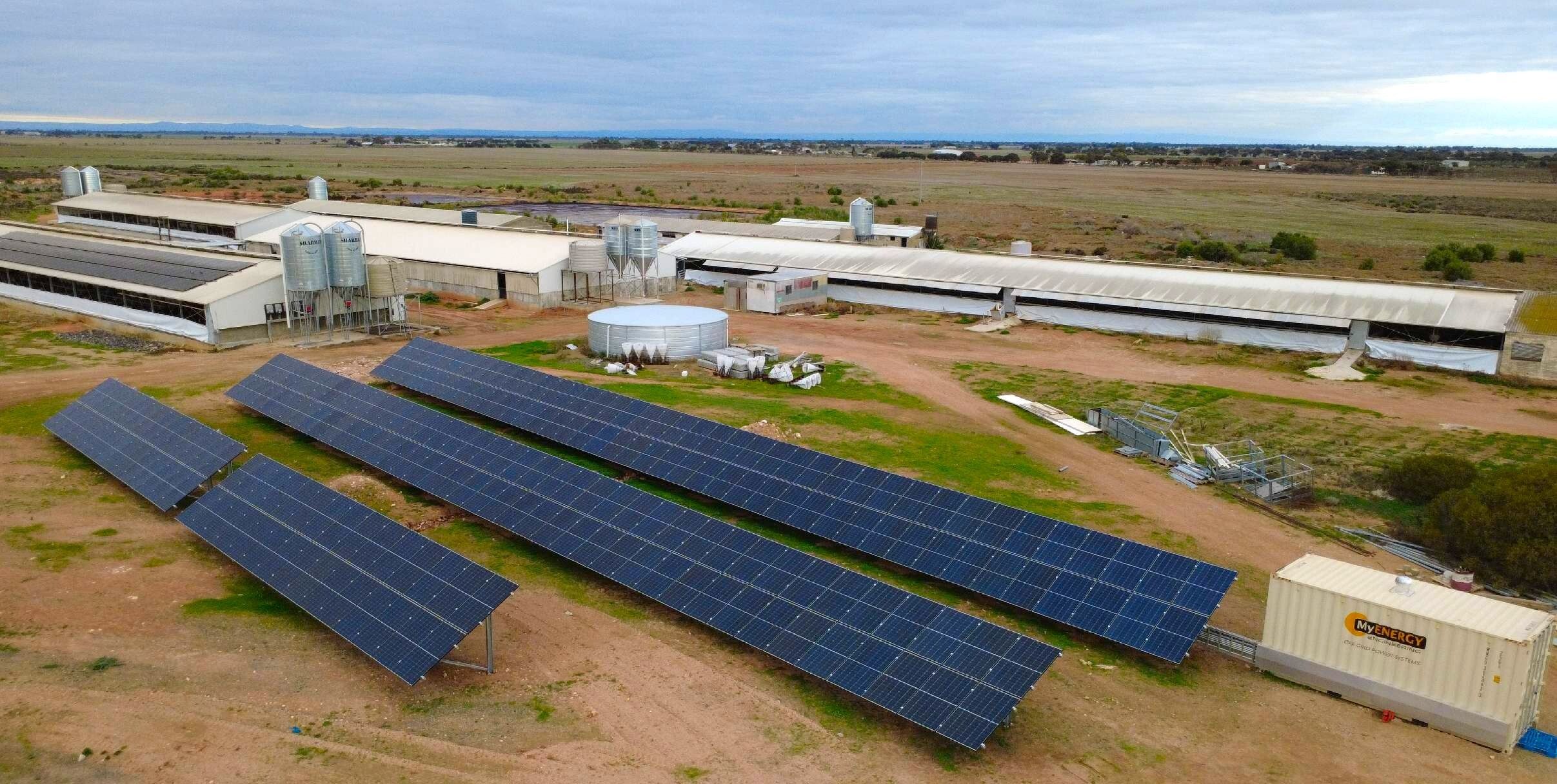
The solar array is the primary energy source. Panel selection, mounting method and array orientation all affect how much energy the system can harvest. On agricultural sites, ground-mounted arrays using pile-driven foundations are common, especially on rocky or uneven terrain where roof mounting is not practical.
Array sizing depends on daily energy demand, location-specific solar irradiance and the margin needed to charge batteries and offset generator run time. Oversizing the array relative to daily consumption allows faster battery charging and reduces reliance on AC or DC coupled generator charging.
Victron Inverter/Chargers
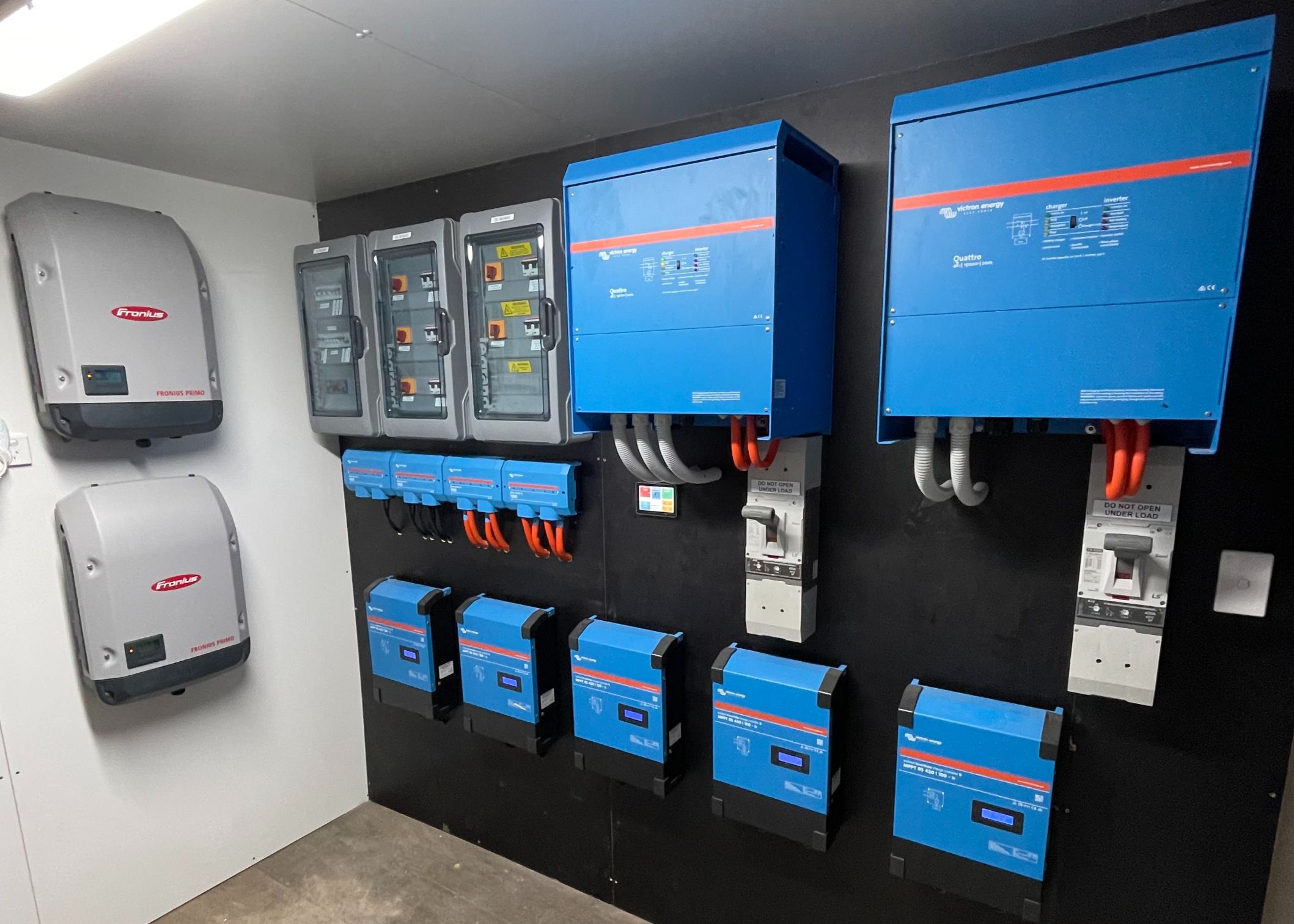
Victron inverter/chargers sit at the centre of the system. They convert DC power from batteries to AC power for the site's loads, manage charging from solar and generator inputs, and regulate voltage and frequency across single or three-phase configurations.
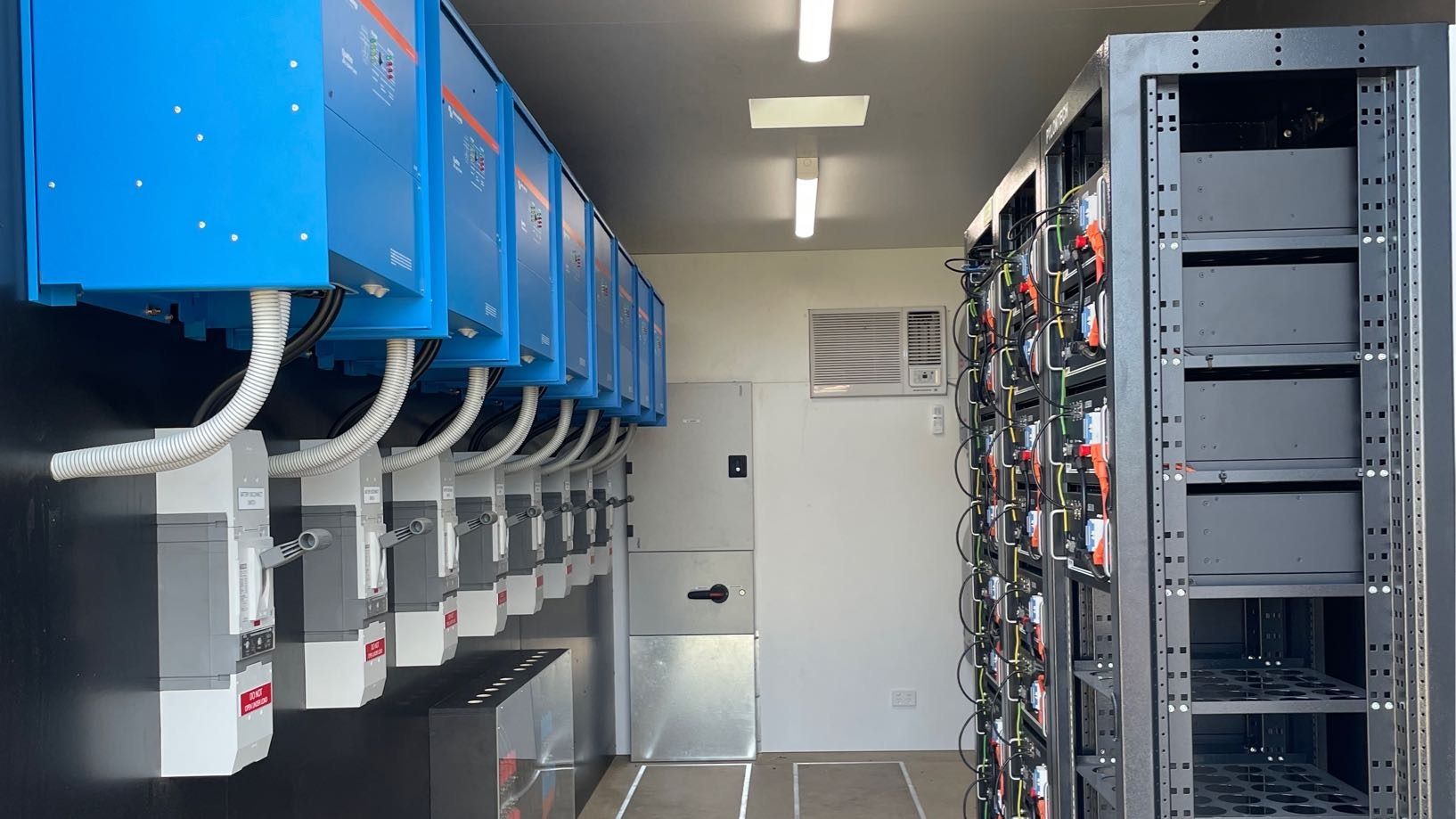
For farm applications, the Victron Quattro range is commonly used because of its dual AC input, high surge rating and ability to run in parallel. On demanding agricultural sites, multiple Quattros can be configured in a three-phase arrangement to balance delivery during high-inrush loads from feed mills, pumps and compressors.
Lithium Battery Storage
Battery storage holds the energy harvested during the day for use overnight, during poor weather and during peak demand. Lithium iron phosphate batteries are the standard for off-grid farm systems in 2026.
They offer faster charge and discharge rates, longer cycle life and better temperature performance compared to the lead-acid banks they are replacing.
Battery capacity is sized around the site's required autonomy. That means calculating how many hours or days the system runs on stored energy alone before the generator or solar array takes over.
On a farm where refrigeration or livestock systems run around the clock, undersizing the battery bank is a common failure point.
Solar Charge Controllers
Victron SmartSolar MPPT charge controllers sit between the solar array and the battery bank, tracking the maximum power point of the array and converting the solar voltage to the correct charging voltage. On large farm systems, multiple charge controllers may be required to handle high-capacity arrays.
Proper MPPT sizing matters. An undersized charge controller clips the solar input and wastes generation capacity. Temperature coefficients of the panels also need to be factored in, as cold mornings can push open-circuit voltage above the controller's rated maximum.
Diesel Generator Integration
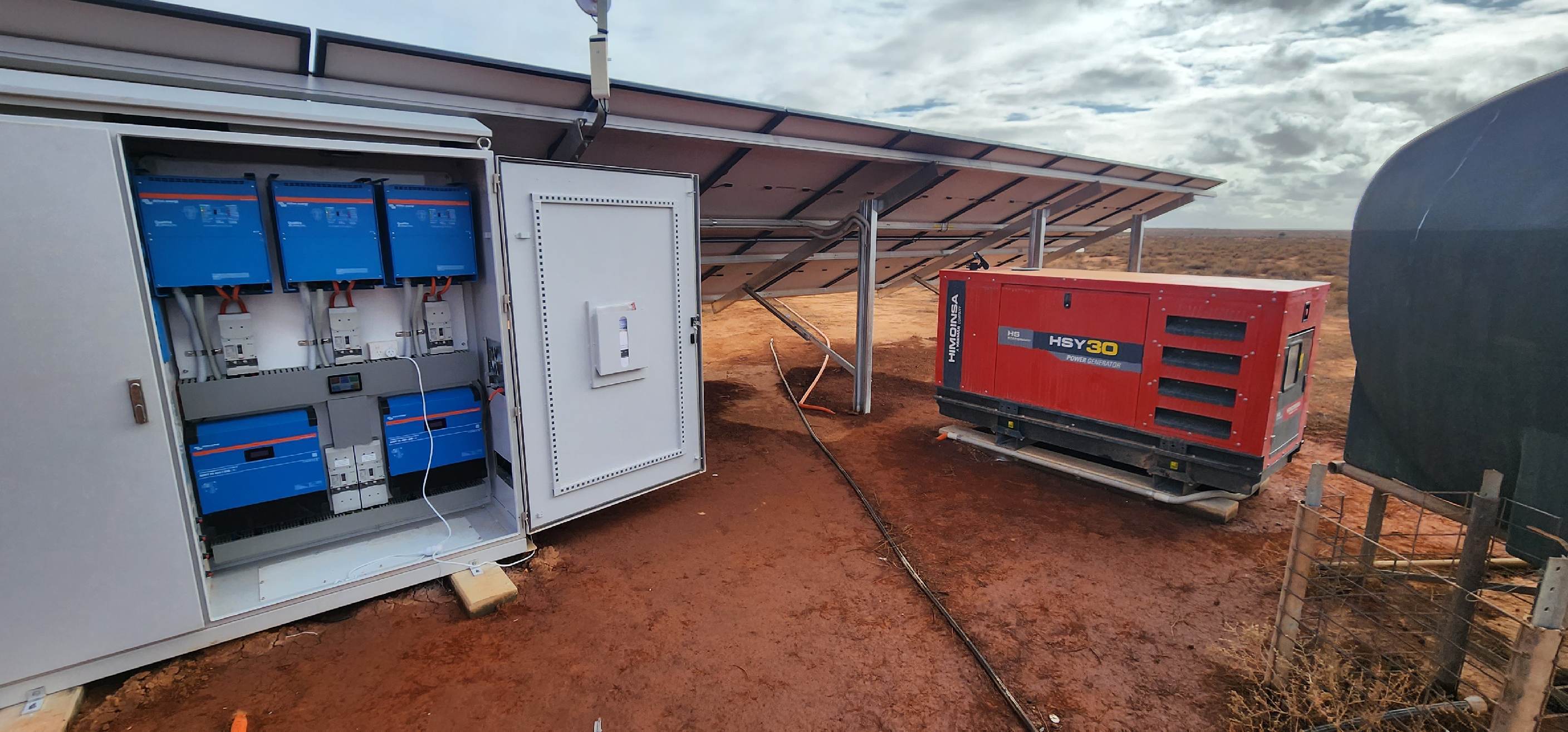
Generators are not optional on most farm off-grid systems. They serve as backup during extended low-solar periods and as a charging source when battery state of charge drops below a set threshold. MyEnergy Engineering integrates 1500rpm water-cooled diesel generators with automatic start and stop control, managed through Victron's GX platform.
The goal is to reduce generator run time, not to eliminate the generator entirely. On most agricultural sites, a well-designed solar and battery system can cut generator use by 70% or more, but the generator still needs to be available for sustained cloudy periods or unexpected load spikes.
Monitoring and Remote Management
Victron Remote Management (VRM) allows real-time monitoring of every system component from any location. Battery state of charge, solar harvest, generator run time, load profiles and fault alerts are all visible through the VRM portal and VictronConnect app.
For farm operators who are not on site every day, remote monitoring is the difference between catching a charging fault early and finding a flat battery bank at 5am when the milking shed needs power.
MyEnergy Engineering uses VRM to support clients remotely and carry out system health checks without a site visit.
How to Size an Off-Grid Power System for Your Farm
Sizing an off-grid farm power system is not a calculation you do with a generic online tool. Every site is different. The process starts with understanding what the system actually needs to support, and working backward from there.
Step 1: Map Your Loads
List every piece of equipment the system will power. Record the rated wattage, hours of operation per day, and whether each load runs continuously or intermittently. Pay close attention to motors and pumps, which draw significantly more power at startup than during steady-state operation.
Group loads by priority. Critical loads like refrigeration and water pumps must run at all times. Non-critical loads like workshop tools or lighting can be scheduled to align with peak solar production.
Step 2: Calculate Daily Energy Demand
Multiply each load's wattage by its daily run hours to get kilowatt-hours per day. Add all loads together to find total daily energy demand. Include a margin of 15 to 25 percent for system losses, cable runs, inverter conversion and battery round-trip losses.
Consider seasonal variation. A farm that uses 40 kWh per day in winter may need 80 kWh per day in summer when irrigation and cooling loads increase. Size the system around the worst-case month, not the annual average.
Step 3: Size the Solar Array
Divide the daily energy demand by the average peak sun hours for your location. In most of regional Australia, that figure falls between 4 and 6 hours depending on season and latitude. Apply a derating factor of 20 to 30 percent to account for panel temperature losses, soiling and shading.
The result is the minimum array size in kilowatts. On farm systems, oversizing the array by 20 to 40 percent is standard practice. A larger array charges batteries faster, reduces generator dependency and gives the system headroom for future expansion.
Step 4: Size the Battery Bank
Battery capacity is determined by autonomy requirements. If you need two days of backup without solar or generator input, multiply daily energy demand by two. Factor in the battery's usable depth of discharge, which for lithium iron phosphate batteries is typically 80 to 90 percent of rated capacity.
On agricultural sites, MyEnergy Engineering typically designs for one and a half to three days of autonomy, depending on the site's access to generator backup and the consequences of a power outage.
Step 5: Select the Inverter Configuration
The inverter must handle the site's peak power demand, including surge loads from motors. Victron inverters are rated for peak output of approximately twice their rating, which helps absorb motor start-up surges.
On three-phase farm systems, three or more Victron Quattros are often configured in parallel per phase to handle high inrush and variable loads.
Inverter selection also depends on generator integration requirements, battery charging capacity and whether AC-coupled solar inverters are part of the system architecture.
Step 6: Specify Generator Backup
Generator sizing depends on the loads it needs to support while simultaneously charging the battery bank. A generator that is too small will run at full capacity for extended periods, increasing fuel consumption and reducing service life. A generator that is too large wastes fuel at low load factors.
The generator needs to be matched to the inverter/charger's AC input capacity and programmed with automatic start/stop triggers based on battery state of charge and load thresholds.
Common Farm Use Cases for Victron Off-Grid Systems
Victron-based off-grid systems are running across a wide range of Australian farming operations. The specifics vary, but the underlying principle is the same: design the system around how the site actually operates.
Dairy Operations
Dairy farms run high-power equipment on tight schedules. Milking machines, refrigeration, water heating and automated feeding systems all need reliable, uninterrupted power. Micro-outages that would go unnoticed in a residential setting can cause equipment faults, lost milk and animal welfare issues on a dairy.
MyEnergy Engineering delivered the off-grid power system for McHugh's Robotic Dairy at Mount Compass, South Australia. That project earned the 2025 National Clean Energy Project of the Year and demonstrates what a properly designed Victron system can handle in a demanding dairy environment.
Broadacre and Livestock Stations
Remote cattle and sheep stations often operate hundreds of kilometres from the nearest grid connection. Power systems on these sites support bore pumps, accommodation, workshops, communications equipment and fencing infrastructure.
MyEnergy has delivered containerised off-grid power systems for remote stations across Far North South Australia and western New South Wales. These systems are built off-site in a controlled environment for quality assurance and then trucked to site for fast commissioning.
Horticulture and Irrigation
Vineyards, orchards and irrigated cropping operations need power for pumps, frost protection fans and cold storage. These loads are often seasonal, which means the system must handle wide variations in demand throughout the year.
Solar pumping systems can run pumps directly from the solar array during daylight hours, with battery backup for early morning or late evening irrigation schedules. MyEnergy designs solar and battery powered pumping solutions for bore, transfer and surface pumps across rural Australia.
Piggeries and Intensive Livestock
Intensive livestock operations have some of the highest and most variable power demands of any farm type. Ventilation, climate control, feeding systems and waste management all run on electricity. A power failure at a piggery can result in rapid stock losses.
A 2026 pv magazine report documented MyEnergy Engineering's delivery of a 100 kW solar and 256 kWh battery system for a large-scale pig farm north of Adelaide.
The site's feed mill created surge demands exceeding 70 kW, requiring precise three-phase control using nine Victron inverters and custom Node-RED automation for generator failover.
Why Victron Components Are Used in Farm Off-Grid Systems
Victron Energy equipment appears in farm off-grid systems across Australia for several practical reasons. The choice is based on field performance, not marketing.
Victron inverters and charge controllers have a modular architecture. You can start with a single-phase system and expand to three-phase by adding inverters. Battery capacity can grow without replacing the existing bank.
Solar charge controllers can be added as the array grows. This modularity matters on farms where energy demand increases over time as operations expand.
Victron's open communication protocol allows integration with third-party batteries, AC-coupled inverters and custom automation through Node-RED. On sites with existing infrastructure, like a Fronius AC solar array or an older generator, the system can be designed to work with what is already in place rather than requiring a full replacement.
Remote monitoring through VRM gives farm operators and their support team full visibility over system performance from anywhere. For sites where a technician visit takes hours or days, remote diagnostics and configuration changes reduce downtime and service costs.
Design Mistakes That Cause Farm Off-Grid Systems to Fail
Systems fail when the design does not account for how the site actually operates. These are the most common problems we see across agricultural off-grid installations.
Undersized Inverters
Choosing an inverter based on average load rather than peak surge demand is a frequent error. Motor-driven equipment like bore pumps, compressors and feed augers draw three to seven times their rated power during startup.
If the inverter cannot handle those surges, it trips repeatedly and the load never runs reliably.
Insufficient Battery Autonomy
A battery bank sized for one day of autonomy may work well for 340 days of the year. The remaining 25 days of poor weather and high demand will push the system into generator-dependent operation.
If the generator is also undersized or out of fuel, the result is a power failure. Design for the worst week, not the average day.
No Generator Integration
Some system designs omit generator backup entirely to reduce upfront cost. On a remote farm site, that means any extended period of low solar production results in a flat battery bank and no power. For most agricultural operations, a properly integrated generator is a non-negotiable part of the system.
Poor Cable and Earthing Design
Voltage drop across long cable runs between the solar array, battery bank and switchboard reduces system performance and can cause protection devices to trip. On farm sites where components may be spread across several hundred metres, cable sizing and earthing design need to be engineered correctly from the start.
How MyEnergy Engineering Approaches Farm Off-Grid Projects
MyEnergy Engineering has been delivering off-grid power systems for Australian farms since 2010. The approach is based on understanding the site first and designing the system second.
Our general approach would be to look at:
- Main loads and expected daily energy use across all seasons
- Peak demand from motors, pumps, refrigeration and other high-inrush equipment
- Site access, layout and conditions that affect installation and future maintenance
- Existing infrastructure including generators, older solar arrays or grid connections
- Battery autonomy requirements based on site remoteness and operational risk
- Future expansion plans for additional sheds, bores, accommodation or processing
Every system is designed, built and installed by our in-house team. Where possible, systems are assembled and tested in our workshop at Lonsdale, South Australia before being shipped to site. This reduces on-site installation time and ensures the system is commissioned correctly.
Support continues after installation. We monitor systems remotely through VRM, carry out scheduled health checks and respond to faults. As farm operations change, we assist with system upgrades and expansions to keep the power system matched to the site's current needs.
What to Expect From Off-Grid Farm Power Technology in 2026 and Beyond
Lithium battery costs have continued to decline, making larger battery banks more accessible for agricultural operations. According to CSIRO's GenCost 2025-26 report, battery storage costs in Australia have fallen further than projected, reinforcing the commercial case for solar and battery systems on farms.
Victron's firmware and software platform receives regular updates that improve system control, generator management and compatibility with new battery chemistries. The Victron GX platform now supports advanced automation through Node-RED, allowing custom control sequences for generator start/stop, load shedding and priority-based power routing.
For farm operators, the practical outcome is that off-grid systems are becoming more capable and more cost-effective. Larger battery banks reduce generator dependency. Better monitoring tools allow tighter control over system performance. Modular hardware makes it possible to expand in stages rather than building the entire system on day one.
In Conclusion: Building Farm Power Systems That Perform
Off-grid farm power is not about buying the right equipment. It is about designing a system that matches how your site actually operates, and building it to handle the conditions your site actually faces.
Victron components give you a modular, field-proven platform. Lithium battery storage delivers the cycle life and charge rates that agricultural operations demand. Generator integration keeps the system running when weather or demand pushes beyond solar and battery capacity alone.
The difference between a system that performs and one that does not comes down to the design. Get the loads right, size the components properly and build in enough autonomy to cover the worst-case periods. That is what MyEnergy Engineering's off-grid design process is built around.
Reliable off-grid power starts with the right design. Built for tough conditions. Backed by real experience.
FAQs About Off-Grid Farm Power Systems With Victron in 2026
What size off-grid system does a typical Australian farm need?
Every farm operates differently. A small grazing property may need 10 to 15 kWh per day, while a dairy or piggery with high-inrush loads could require 80 kWh or more.
MyEnergy Engineering sizes each system around the site's actual loads, autonomy requirements and seasonal variation.
Can I expand a Victron off-grid system later?
Victron's modular architecture supports staged expansion. You can add inverters, battery modules and solar capacity without replacing existing equipment. MyEnergy Engineering designs systems with future growth in mind, so expanding later is a planned capability rather than a retrofit.
Do I still need a generator with solar and battery storage?
For most farm sites, a generator remains an important part of the system. Extended periods of poor weather can deplete even a well-sized battery bank. A properly integrated generator with automatic start based on battery state of charge keeps your site running through those periods without manual intervention.
How does Victron Remote Management help farm operators?
Victron's VRM portal and VictronConnect app give you real-time visibility over battery state of charge, solar production, generator run time and load data from any device. MyEnergy Engineering uses VRM to carry out remote health checks and catch faults early, reducing the need for on-site service visits.
What makes MyEnergy Engineering different for farm off-grid systems?
MyEnergy Engineering has designed and installed off-grid power systems for Australian farms, stations and rural operations since 2010. We are a long-standing Victron Energy distributor and service agent.
Every system is designed, built and supported by our in-house team, with ongoing remote monitoring and field support backed by real experience.
← Back to all articles